
One small step forward.
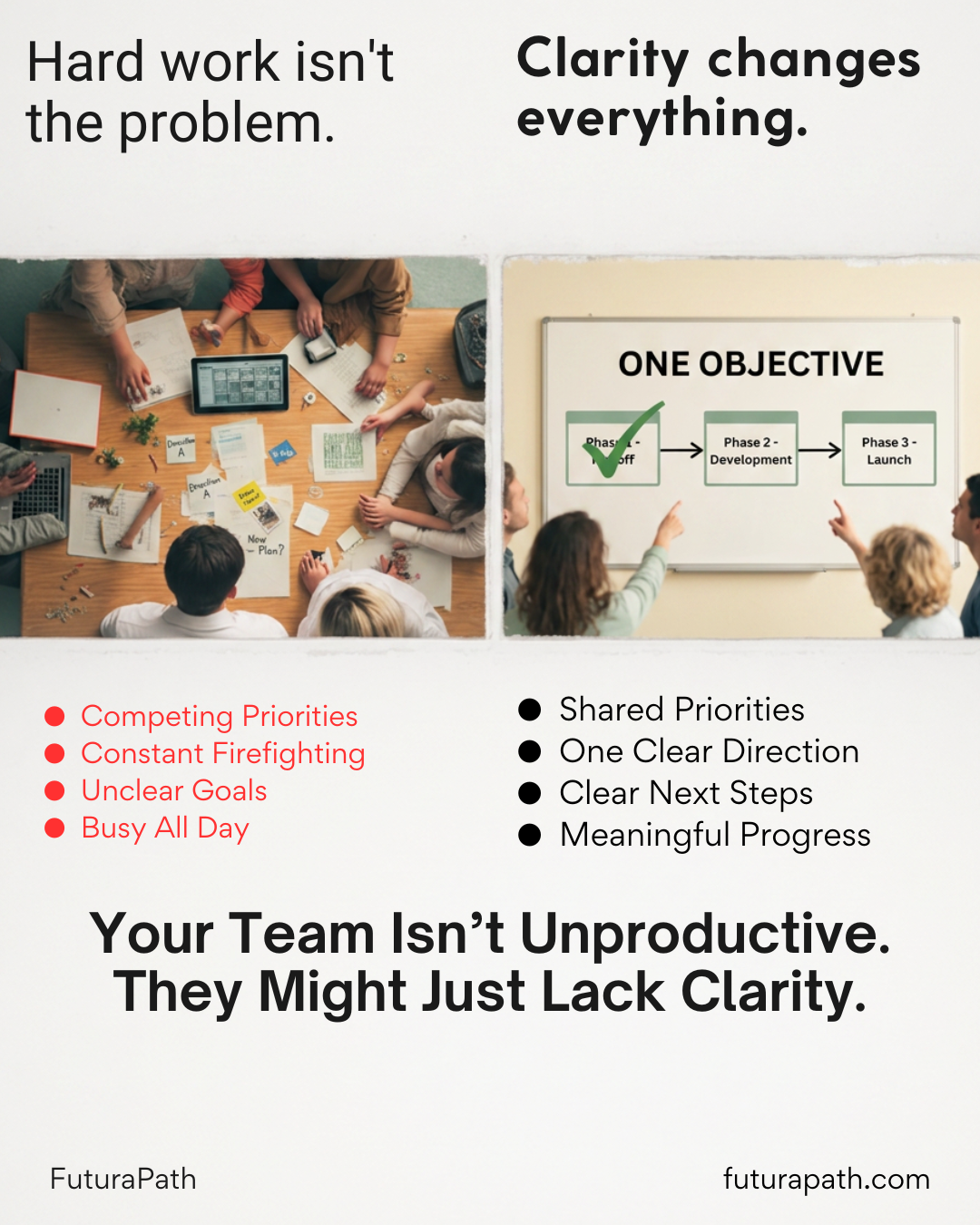
Your Team Isn't Unproductive. They Might Just Lack Clarity.
When capable people work hard but progress remains difficult to see, the missing ingredient is often a shared understanding of what matters most and what happens next.
It is Thursday afternoon.
The team has been moving continuously since Monday. Slack has rarely been quiet. Calendars are full. A production issue was contained, customer questions were answered, pull requests were reviewed, and meetings filled the spaces between them.
Everyone looks tired. Nobody looks disengaged.
Then, during the weekly check-in, someone asks a simple question: What did we move forward that will still matter next month?
The room goes quiet.
There are plenty of completed activities to name, but no shared answer. The important initiative is still partially defined. Several people believe different work is most urgent. Two decisions are waiting for owners.
This is often described as a productivity problem. It is usually something else.
The problem is not effort. It is direction.
Teams rarely stall because people are unwilling to work. They stall because legitimate demands compete, trade-offs remain unresolved, and people must repeatedly guess what deserves attention. Everyone is moving, but the work does not accumulate in one direction.
Busy Does Not Equal Progress
Modern knowledge work makes activity easy to see and progress surprisingly difficult to judge. Meetings attended, tickets closed, messages answered, and documents reviewed all leave a visible trail. The harder work often does not.
A product boundary made clearer, a recurring incident prevented, or a difficult decision finally closed may create more value than a week of rapid responses. Yet those outcomes usually require sustained attention, judgment, and a willingness to leave some requests unanswered for a while.
This creates a predictable management trap. Leaders see motion and assume momentum. Teams learn that responsiveness is safer than depth. The organization becomes effective at acknowledging work while the strategic issue - the platform redesign, the launch decision, the operating model, the customer problem that crosses teams - advances in fragments.
This is the pattern explored in Busy All Day But Not Moving Forward. Activity can be necessary and useful without adding up to the outcome the organization says it wants.
The question is not whether people are working. It is whether enough of that work points toward the same result long enough to matter.
The Four Signs Your Team Has a Clarity Problem
A lack of shared direction rarely announces itself directly. It appears through operating patterns that can look like commitment, flexibility, or healthy debate.
The following signs are not a scientific diagnostic. They are useful leadership signals: reasons to inspect the system before asking people for more output.
-
Every request feels urgent
Slack messages arrive with deadlines implied but not negotiated. A customer escalation, an executive question, and an internal improvement all enter the same queue as if they carry equal consequences. The leadership cost is that urgency becomes a tone rather than a decision. For example, an engineer may abandon planned reliability work to produce data for a meeting that could have waited two days. The issue is not poor discipline; nobody defined which request outranks which outcome.
-
People switch priorities constantly
Work begins, pauses, restarts, and changes owners. Roadmap items remain in progress across several planning cycles because the team keeps responding to the newest demand. The consequence is not only delay. People stop trusting that the current plan will survive, so they invest cautiously and keep several options open. A designer who revises the same flow for three different stakeholder directions is not resisting execution. The decision boundary is unstable.
-
Progress is difficult to describe
Updates become lists of activity: meetings held, tickets touched, research completed, and conversations started. When asked what changed for a customer or the business, the answer is less clear. This usually means success was never made specific enough to guide choices. A platform team can complete documentation, automation, and migration tasks while still being unable to say whether developers can ship faster or more safely.
-
Team members give different answers about what matters most
Ask five people independently: What is our most important objective this month? One person may name the launch, another reliability, another a customer commitment, and another cost reduction. Different language is normal; materially different outcomes are a warning. It suggests that priorities, ownership, or timing have not been resolved at the leadership level. The team may not have a productivity problem. It may be making reasonable decisions from five different versions of the plan.
These patterns should not be used to blame employees. They are evidence about the environment in which employees are being asked to decide.
When Legitimate Priorities Collide
Consider a product and engineering group approaching the end of a quarter.
Product needs a feature released because customer research supports it and the roadmap depends on the learning. Sales has promised a related capability to a major account. Engineering wants to address technical debt that is slowing every change. Operations is dealing with production instability. Then a senior stakeholder introduces another request tied to an upcoming board discussion.
Every request is legitimate. That is precisely why the conflict is difficult.
If leadership simply tells the team to move faster, the conflict does not disappear. Product continues preparing the launch. Sales pulls an engineer toward the customer request. Operations interrupts whoever understands the affected service. Technical debt work happens between incidents. The new executive request receives immediate attention because it has the strongest sponsor.
By Friday, everyone has worked hard. Several streams have moved slightly. Nothing important is ready to finish.
The leader's job is to resolve the collision in public. Suppose production stability is the primary objective for the next two weeks because the current failure rate threatens every other commitment. The feature launch becomes secondary and retains a smaller discovery track. The customer-specific request is renegotiated with Sales. The board request gets one named owner and a time-boxed response. Broader debt work pauses except where it directly improves stability.
Success is defined before the plan expands: reduce the repeat failure mode, complete the protective control, and operate for seven days without the same incident. The next step is also explicit: the incident owner and two engineers will review the last three failures tomorrow morning and agree on the common cause.
This decision will disappoint someone. Prioritization often does. But it gives the team a coherent basis for action, ownership, and escalation.
Not everything can be first. Leadership begins where the organization chooses what receives preference when worthwhile demands compete.
Context Switching Costs More Than Leaders Realize
Interruptions are usually measured by their visible duration: a quick message, a fifteen-minute call, a review before lunch. For knowledge workers, that is incomplete.
Engineering and product work depend on mental context. A developer changing a complex service may be holding the failure mode, data flow, recent code changes, test assumptions, and operational constraints in mind. A product leader comparing roadmap options is carrying customer evidence, dependencies, commercial commitments, and sequencing.
When that work is interrupted, the clock does not simply pause. The original context must be reconstructed later, and unfinished work continues to occupy attention.
Harvard Business Review describes this through attention residue: interruptions fragment time and make clean transitions between unfinished tasks difficult.
Cal Newport's concept of deep work and Paul Graham's Maker's Schedule, Manager's Schedule point to the same practical reality: a meeting that fits neatly into one person's calendar can break the long block another person needs to produce.
Teams still need responsiveness. The leadership task is to design it: clear escalation criteria, incident rotations, office hours, and protected blocks that make focused work structurally possible.
Busy Work and Clear Work Create Different Systems
The difference is easier to see as two reinforcing patterns. One multiplies motion; the other turns attention into progress.
Busy
- More meetings
- More interruptions
- More context switching
- More activity
- Little meaningful progress
Clear
- One objective
- Shared priorities
- Focused work
- Clear next steps
- Meaningful progress
The second pattern is not silent or inflexible. It simply gives communication and adaptation a shared point of reference.
Teams Need One Clear Direction
High-performing teams are not free from ambiguity. Markets change, systems fail, and plans encounter reality. What distinguishes a focused team is that people know which ambiguity they are trying to resolve.
At any important point, the team should be able to answer four questions: What matters most now? Why does it matter? What evidence will show success? What are we deliberately not working on?
Those answers create a decision system. They help an engineer choose between a broad refactor and a narrow reliability fix. They help a product manager decide whether a new request belongs in the current release. They help a director respond to a stakeholder without escalating every choice.
The Atlassian Team Playbook offers a useful structure: define the goal, signals that indicate movement, and measures that describe success. The point is to connect outputs to an outcome instead of allowing completed tasks to become the definition of progress.
One direction does not require one method. Teams can explore several approaches and adapt as they learn. What remains stable is the outcome against which those choices are judged.
High-performing teams are not always the busiest teams. They are usually the clearest about what matters next.
10-15 minute alignment exercise
Try This With Your Team
Use this at the start of a team meeting or planning session. Ask everyone to write their answers independently before anyone discusses them:
- What is our most important objective this month?
- What is your most important priority this week?
- What work can safely wait?
Compare the responses. Look for differences in the objective, ownership, timing, and definition of success. Pay attention to work that one person considers essential and another believes can wait.
Treat disagreement as information, not evidence that someone failed to listen. People may be responding sensibly to different stakeholder messages, incentives, or assumptions.
End by agreeing on one shared objective, what will not receive attention now, and the next action that will move the objective forward. Write the decision where the team will see it after the meeting.
Turn the Objective Into a Clear Next Step
Direction at the top is necessary, but it is not enough. A team can understand the strategy and still stall because the work directly in front of them remains too large or undefined.
Improve onboarding. Modernize the platform. Strengthen leadership capability. Expand into a new market. Each phrase points somewhere useful, but none tells a person what to do at 9:30 on Tuesday morning.
A useful next step is visible, owned, and connected to the outcome. For onboarding, it might be to watch three recent customers attempt the first-run experience. For platform reliability, it might be to document the current deployment path for one representative service. For a decision-rights problem, it might be to write the two decisions that managers keep escalating.
This is the practical logic behind micro-goals. A large objective supplies direction; a small, specific action supplies traction.
Waiting for a complete plan can become another form of delay. Why Waiting Until You Feel Ready Keeps You Stuck explores how action often produces the information people expect to have before they begin.
The next step should not be small for its own sake. It should be small enough to begin, important enough to teach, and directly connected to the result the team chose.
Clarity Is a Leadership Responsibility
Telling people to focus does not create focus. If five stakeholders can redirect the same team, if success remains vague, or if every request enters as urgent, concentration becomes an individual struggle against an organizational design.
Leaders create better conditions by reducing competing priorities and explaining why the chosen outcome matters. They define success before the work expands. They clarify who owns the decision, who contributes, and who needs to be informed.
They protect focused time and resolve conflicts between stakeholders instead of passing those conflicts down to individual contributors. They say what will not be worked on. They repeat the priority through planning, reviews, and everyday decisions so the message survives contact with the calendar.
When circumstances genuinely change, they change direction explicitly. They explain what new information changed the decision, what is now primary, and what will pause. That preserves trust even when the plan must move.
Pressure asks people to work harder inside the same unresolved system. Clear direction helps people make better decisions without seeking permission at every turn.
For a practical view of applying these ideas to personal leadership priorities, see How Leaders Can Use FuturaPath to Focus on the Work That Matters.
The same principle applies outside formal people leadership. Whether someone leads a 50-person organization, manages a cross-functional project, or plans an individual week, the work becomes easier to sustain when the most important outcome and next action are visible.
Ask a Better Leadership Question
Leaders often ask how to make a team more productive. A better first question is: Does everyone know what matters most?
When the answer is genuinely yes, everyday work changes. Decisions become easier because people have a basis for trade-offs. Meetings become shorter because the outcome is already named. Interruptions decline because fewer requests qualify as urgent. Ownership becomes easier to see, and progress can be described in terms of what changed rather than how much activity occurred.
None of this removes hard work or uncertainty. It makes both more useful.
Clarity is not a productivity hack. It is a leadership responsibility.
FuturaPath is built around the same principle: progress becomes easier when the next step is clear. Whether you are leading a team or planning your own work, turn the objective into one manageable next step.
One small step forward.
FAQ
How can a leader tell whether a team has a productivity or clarity problem?
Look beyond activity. If requests all feel urgent, priorities change frequently, progress is hard to describe, or people disagree about the main objective, inspect direction and trade-offs before asking for more output.
What should a leader clarify first when priorities compete?
Name the primary outcome, explain why it matters, define success, assign ownership, and state which lower-priority work will pause. A priority becomes useful when it changes how competing requests are handled.
How can teams reduce context switching at work?
Use clear escalation criteria, rotate incident coverage, protect focus blocks, group non-urgent questions, and make the current objective visible. The goal is not silence; it is a deliberate path for interruptions.
One Clear Next Step
Ready to bring more clarity to your work?
FuturaPath helps individuals and leaders turn important objectives into manageable next steps, so progress is easier to begin and sustain.