
One small step forward.
How to Plan Your Week When Everything Feels Important
A simple 20-minute method for choosing what matters, protecting realistic time, and making meaningful progress.
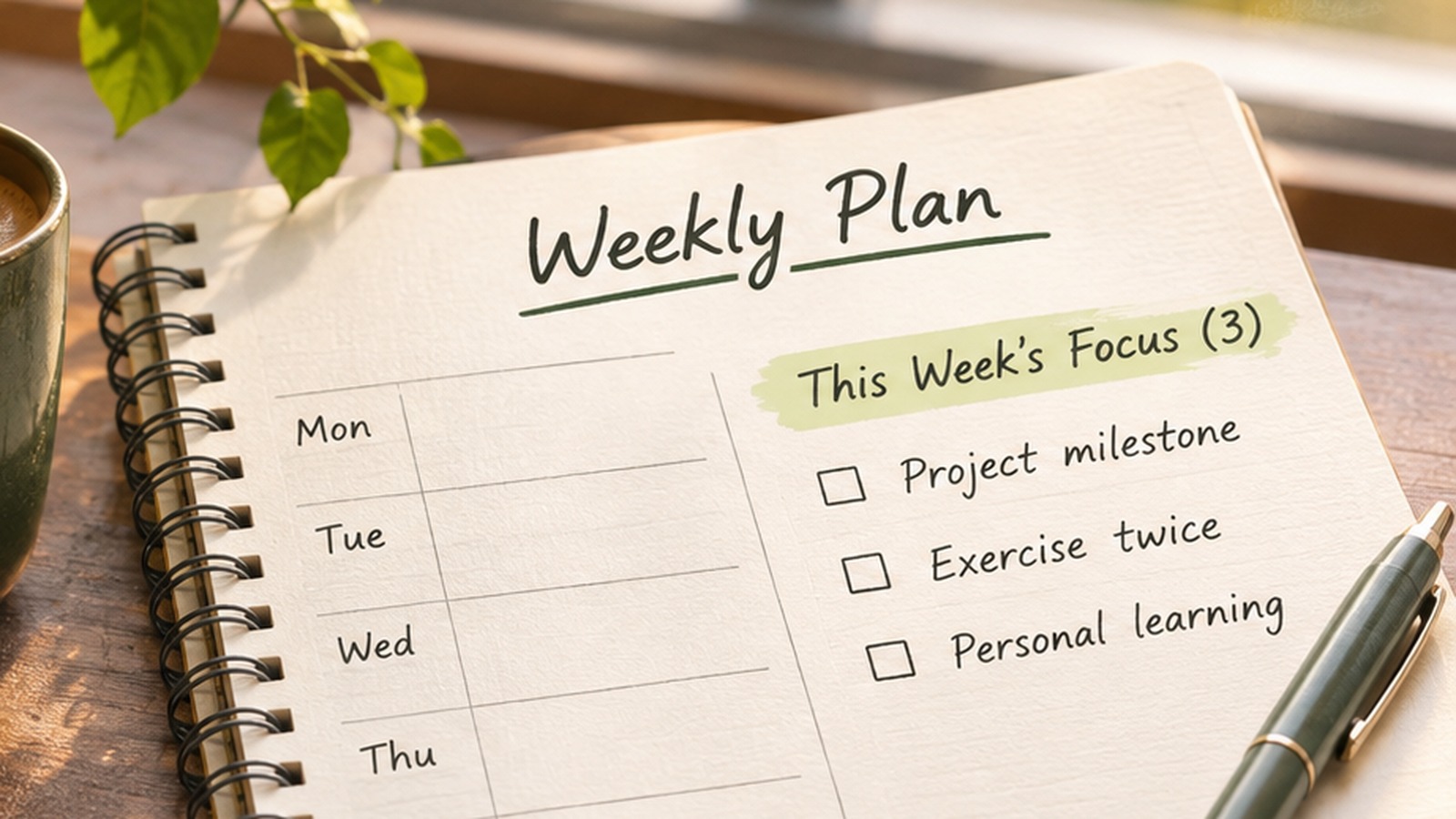
Some weeks feel crowded before they begin. Work has deadlines, family needs attention, messages are waiting, appointments are fixed, and personal goals still matter. When every item feels important, choosing one thing can feel irresponsible. The result is often a long list that represents everything you care about but gives you no realistic way to move through the week.
Weekly planning is not about fitting every responsibility into a perfect schedule. It is about making a few deliberate choices before urgency makes them for you. A useful plan leaves room for the week you are actually going to have, including interruptions, recovery, and ordinary human limits.
This guide offers a 20-minute method for turning a crowded week into three meaningful outcomes and one clear Monday action.
A good weekly plan does not hold everything. It protects what matters most in the time you really have.
Why Everything Feels Equally Important
Importance is not the same as immediacy. A work deadline may be fixed, a family responsibility may be non-negotiable, and exercise may support your health without having anyone waiting for it today. Personal learning or a creative project can matter deeply while remaining easy to postpone.
When these categories sit in one undifferentiated list, the brain has to make the prioritization decision repeatedly. Every item looks like a demand, so the loudest or most recent demand wins. A weekly plan creates a short pause where you can distinguish obligations from aspirations and choose what deserves protected attention.
Why Traditional Weekly To-Do Lists Fail
A traditional weekly list often measures ambition rather than capacity. It collects every task that would be useful, then quietly assumes that the week will contain uninterrupted time, stable energy, and no surprises. That assumption turns a list into a source of failure before Monday is over.
Long lists also hide different kinds of work. A fifteen-minute phone call, a two-hour report, a recurring household task, and a vague aspiration such as improve fitness may appear as equal lines. They are not equal commitments, and they cannot be planned well until their size and type are visible.
The answer is not a more elaborate list. It is a smaller set of outcomes connected to available time. This gives the week a direction without pretending that everything else has stopped existing.
The 20-Minute Weekly Planning Method
Set a timer for twenty minutes. Use paper, a notes app, or any trusted place. The method is deliberately short so planning does not become another project.
1. Capture all commitments — 4 minutes. Write down meetings, deadlines, appointments, family responsibilities, errands, and anything already promised. Do not organize yet. The goal is to stop carrying the reminders in your head.
2. Separate obligations from aspirations — 4 minutes. Mark what must happen, what would be valuable, and what can wait. Obligations have consequences if missed. Aspirations matter but need a realistic place rather than an automatic promise. This distinction makes it easier to protect one personal priority without pretending every priority can receive equal time.
3. Choose three meaningful weekly outcomes — 4 minutes. Pick up to three results that would make the week feel worthwhile. An outcome is more useful than a category: submit the project outline is clearer than work; complete two strength sessions is clearer than fitness; have one unhurried family evening is clearer than family time.
4. Match priorities to realistic available time — 5 minutes. Look at the actual week. Subtract work hours, travel, sleep, meals, care, and recovery. Then place each outcome into a time window that exists. If the time is not there, reduce the outcome. A plan that fits seventy percent of the available capacity is stronger than one that requires a perfect week.
5. Identify Monday's first small action — 3 minutes. Choose the first visible move for the most important outcome. Open the document and write the headings. Put walking shoes by the door. Send the message that confirms the appointment. The first action should be small enough to start before the week gathers speed.
Copy this weekly planning template:
- This week's three outcomes: 1) ______ 2) ______ 3) ______
- Fixed commitments and available windows: ______
- What I will intentionally defer: ______
- Monday's first small action: ______
The method works because it turns a crowded list into a limited set of choices and connects those choices to real time.
A Real-Life Example
Imagine a project manager with a demanding workweek, two children, a partner, and a goal of improving their health and professional skills. Their first list includes a client presentation, school forms, groceries, exercise, a course, messages, laundry, and a personal project. Everything feels important.
During the four-minute capture, all of it is written down. The manager then separates obligations from aspirations: the client presentation and school forms are fixed; exercise, the course, and the personal project are valuable but flexible. The three outcomes become: finish the presentation outline, complete two twenty-minute workouts, and spend one focused hour on the course.
Looking at the calendar reveals two realistic exercise windows before work and one quiet hour on Saturday morning. The personal project is intentionally deferred. Monday's first action is to open the presentation and write three sections before checking messages. The week still contains errands and interruptions, but its priorities are no longer competing for an imaginary amount of time.
What to Do When Plans Change
A plan is a guide, not a contract with the future. When an urgent request, illness, or unexpected family need changes the week, do not treat the whole plan as invalid. Reopen the three outcomes and ask which one still matters most, which can be reduced, and which can move without consequence.
Use a smaller version when necessary. Two workouts can become one walk. A complete presentation can become a solid outline. A full course session can become ten minutes of review. This is not abandoning the priority; it is adapting its size to the new conditions.
The article <a href="/blog/busy-all-day-but-not-moving-forward">Busy All Day But Not Moving Forward?</a> explores a related distinction: activity can fill a day without moving the important work forward. A weekly reset helps you notice that gap early and choose one focused next action.
A Simple Five-Minute Weekly Review
At the end of the week, answer three questions without grading yourself:
1. What moved forward, even if it was smaller than planned?
2. What consumed more time or energy than expected?
3. What should I carry forward, reduce, defer, or drop next week?
These questions turn experience into better planning information. They help you learn your actual capacity instead of repeatedly planning for an ideal version of yourself.
Plan Less, Notice More
A realistic week is not empty of responsibility. It simply gives responsibility a shape you can use. By choosing three outcomes, matching them to real windows, and identifying one small Monday action, you create a plan that can bend without breaking.
FuturaPath can support this process by giving priorities, goals, and Micro-goals a connected place to live. You can turn a weekly outcome into one visible next step, schedule it when useful, complete it, and reflect before choosing again. The tool is not a substitute for judgment; it helps keep the judgment and the next action from getting lost.
You do not need to solve the whole week at once. Start with what matters, make the time honest, and take one small step forward.
One Small Step Forward
Give this week one clear place to begin.
Turn a meaningful weekly outcome into a Micro-goal you can start today.